The question of whether we use Latin in the liturgy is ultimately of little importance since even when translated, liturgy and Scripture on a fundamental level no longer make sense to modern man. Sure, we can try to extract dogma and morals from them like juice from an orange, but in the end, I fear, all we will get is an inverted, crypto-pious image of ourselves staring back at us. Some may call this: “inculturation”. Pardon me if I give it what I feel to be a more accurate name: “narcissism”. (my emphasis)
Showing posts with label Hadot. Show all posts
Showing posts with label Hadot. Show all posts
Monday, January 11, 2010
Pierre Hadot loses his faith
I came across this short biographical piece on Pierre Hadot losing his faith. The blogger stumbled upon an intractable problem for Christianity:
Monday, November 30, 2009
Epicurean "fourfold remedy"
The gods are not to be feared,
Death is not to be dreaded;
What is good is easy to acquire
What is bad is easy to bear.
Death is not to be dreaded;
What is good is easy to acquire
What is bad is easy to bear.
h/t Pierre Hadot
Sunday, September 28, 2008
Pierre Hadot on Socrates' task
Socrates' task--entrusted to him, says the Apology, by the Delphic oracle (in other words, the god Apollo)--was therefore to make other people recognize their lack of knowledge and of wisdom. In order to accomplish this mission, Socrates himself adopted the attitude of someone who knew nothing--an attitude of naiveté . This is the well known Socratic irony: the feigned ignorance and candid air with which, for instance, he asked questions in order to find out whether someone was wiser than he. In the words of a character from the Republic: "That's certainly Socrates' old familiar irony! I knew it. I predicted to everyone present, Socrates, that you'd refuse to reply, that you'd feign ignorance, and that you'd do anything but reply if someone asked you a question."
This is why Socrates is always the questioner in his discussions. As Aristotle remarked, "He admits that he knows nothing." According to Cicero, "Socrates used to denigrate himself, and conceded more than was necessary to the interlocutors he wanted to refute. Thus, thinking one thing and saying another, he took pleasure in that dissimulation which the Greeks call 'irony.'" In fact, however, such an attitude is not a form of artifice or intentional dissimulation. Rather, it is a kind of humor which refuses to take oneself or other people seriously; for everything human, and even everything philosophical, is highly uncertain, and we have no right to be proud of it. Socrates' mission, then, was to make people aware of their lack of knowledge.
...
The real problem is therefore not the problem of knowing this or that, but of being in this or that way: "I have no concern at all for what most people are concerned about: financial affairs, administration of property, appointments to generalships, oratorical triumphs in public, magistracies, coalitions, political factions. I did not take this path... but rather the one where I could do the most good to each one of you in particular, by persuading you to be less concerned with what you have than what you are; so that you may make yourselves as excellent and as rational as possible." Socrates practiced this call to being not only by means of his interrogations and his irony, but above all by means of his way of being, by his way of life, and by his very being.
Pierre Hadot What is Ancient Philosophy p. 26,29*
Monday, June 9, 2008
"It is more important to want the good than it is to know the truth."
In the fourteenth century, Petrarch rejected the idea of a theoretical and descriptive ethics, noting that reading and commenting upon Aristotle's treatises on the subject had not made him a better person. He therefore refused to apply the term "philosophers" to "professors sitting in a chair," and reserved the word for those who confirmed their teachings by their acts. It is to Petrarch that we owe the following remark, which is essential to the perspective we are investigating: "It is more important to want the good than it is to know the truth." We find the same attitude in Erasmus when he repeatedly affirms that the only philosopher is the person who lives philosophically, as did Socrates, Diogenes the Cynic, and Epictetus, but also like John the Baptist, Christ, and the Apostles. We must note that when Petrarch and Erasmus speak of the philosophical life, they, like some Church Fathers and some of the monks, have in mind a Christian philosophical life. As we have seen, moreover, they admitted that some pagan philosophers also realized the ideal of the philosopher.
During the Renaissance, we see the renewal not only of the doctrinal tendencies of ancient philosophy but also of its concrete attitudes: Epicureanism, Stoicism, Platonism, Skepticism. Montaigne's Essays, for example, show the philosopher trying to practice the various modes of life proposed by ancient philosophy: "My trade and my art is living." His spiritual itinerary led him from the Stoicism of Seneca to the probabilism of Plutarch, through Skepticism, and finally --definitively-- to Epicureanism: "'Today I did nothing.''What? Have you not lived? Not only is that the fundamental point, but it is the most illustrious of your occupations... Our great and glorious masterpiece is to live appropriately. To know how to loyally delight in our being is a perfection which is absolute, and as if divine.'"
Michel Foucault held that the "theoreticizing" of philosophy began with Descartes, not in the Middle Ages. As I have said elsewhere, I agree with him when he says: "Before Descartes, a subject could have access to the truth only by carrying out beforehand a certain work upon himself which made him susceptible of knowing the truth." (emphasis mine)
Pierre Hadot What is Ancient Philosophy p. 262-263
Tuesday, May 13, 2008
philosophy as therapy
At first glance, in fact, one might wonder if the conceptions of wisdom were really all that different among the schools. All Hellenistic schools seemed to define it in approximately the same terms: first and foremost, as a state of perfect peace of mind. From this viewpoint, philosophy appears as a remedy for human worries, anguish, and misery brought about, for the Cynics, by social constraints and conventions; for the Epicureans, by the quest for false pleasures; for the Stoics, by the pursuit of pleasure and egoistic self interest; and for the Skeptics, by false opinions. Whether or not they laid claim to the Socratic heritage, all Hellenistic philosophers agreed with Socrates that human beings are plunged in misery, anguish, and evil because they exist in ignorance. Evil is to be found not within things, but in the value judgments which people bring to bear upon things. People can therefore be cured of their ills only if they are persuaded to change their value judgments, and in this sense, all these philosophies wanted to be therapeutic. In order to change our value judgments, however, we must make a radical choice to change our entire way of thinking and way of being. This choice is the choice of philosophy, and it is thanks to it that we may obtain inner tranquility and peace of mind.I like this quote in conjunction with this Nietzschean pluralism I posted a while ago.
Pierre Hadot "What is Ancient Philosophy" p. 102
Being philosophically minded. -- We usually endeavour to acquire a single deportment of feeling, a single attitude of mind towards all the events and situations of life - that above all is what is called being philosophically minded. But for the enrichment of knowledge it may be of more value not to reduce oneself to uniformity in this way, but to listen instead to the gentle voice of each of life's different situations; these will suggest the attitude of mind appropriate to them. Through thus ceasing to treat oneself as a single rigid and unchanging individuum one takes an intelligent interest in the life and being of many others. (HAH, I, 618)What I really want to say though is this --
Whatever you are after, head straight for it. Don't get caught up in distractions. (false religion/false philosophy/etc.)
Wednesday, May 7, 2008
Jim Garrison on Radio Active
I was minding my own business yesterday, doing some work on the computer when I heard someone on the radio going off about philosophy as a way of life. I thought, "hey, I go off about philosophy as a way of life". I kept listening. The speaker seemed to be talking about Pierre Hadot but not referencing him explicitly so I called to put a good word in for the frenchman. I also was asking that "cultural creative" types put a hand out towards "enlightened Christians" who embrace the genuine values in Christianity. I put a word in for Obama, not that he needed it on a show like radio active.
I'm not completely on board with everything Jim Garrison is about but I really enjoyed what he had to say on the radio show. He's fairly quick to dismiss the Abrahamic religions (Islam, Judaism, Christianity). If you want to hear my whiny, high pitched stutterings, my call is about half way in. If you have time though, I think the whole show is pretty good.
May 6th Radio Active Program on KRCL
Some other quotes by Jim Garrison
I'm not into meditation so much as learning trades and skills. I also relate more to the TED types. We make personal progress as we take on difficult ("interesting") tasks.
Philo of Alexandria - Hellenistic Jewish Philosopher
I'm not completely on board with everything Jim Garrison is about but I really enjoyed what he had to say on the radio show. He's fairly quick to dismiss the Abrahamic religions (Islam, Judaism, Christianity). If you want to hear my whiny, high pitched stutterings, my call is about half way in. If you have time though, I think the whole show is pretty good.
May 6th Radio Active Program on KRCL
Some other quotes by Jim Garrison
"One of the things I find very exciting about spirituality in the world today is that it is disengaged from religion. Religious orthodoxy is becoming less and less relevant to more and more people," says Dr Garrison, a Harvard graduate with a PhD in theology.It seems a bit new agey (what's with all the spiraly images on that page?) but here's Garrison's explanation of what he means by "cultural creatives".
"I think that Judaism and Christianity and Islam have done real damage to the planet because they have too many answers. I prefer to live in the questions.
"I believe deeply in the Christian truths, but I think that they are partial. I think it's important that whatever we conceive of as God is the God of the whole not God of the part.
"If you think of all the violence that has been engendered because by people that believe the part is the whole it makes you shudder," he says.
[article]
I'm not into meditation so much as learning trades and skills. I also relate more to the TED types. We make personal progress as we take on difficult ("interesting") tasks.
Philo of Alexandria - Hellenistic Jewish Philosopher
Tuesday, April 1, 2008
Socrates' Mask
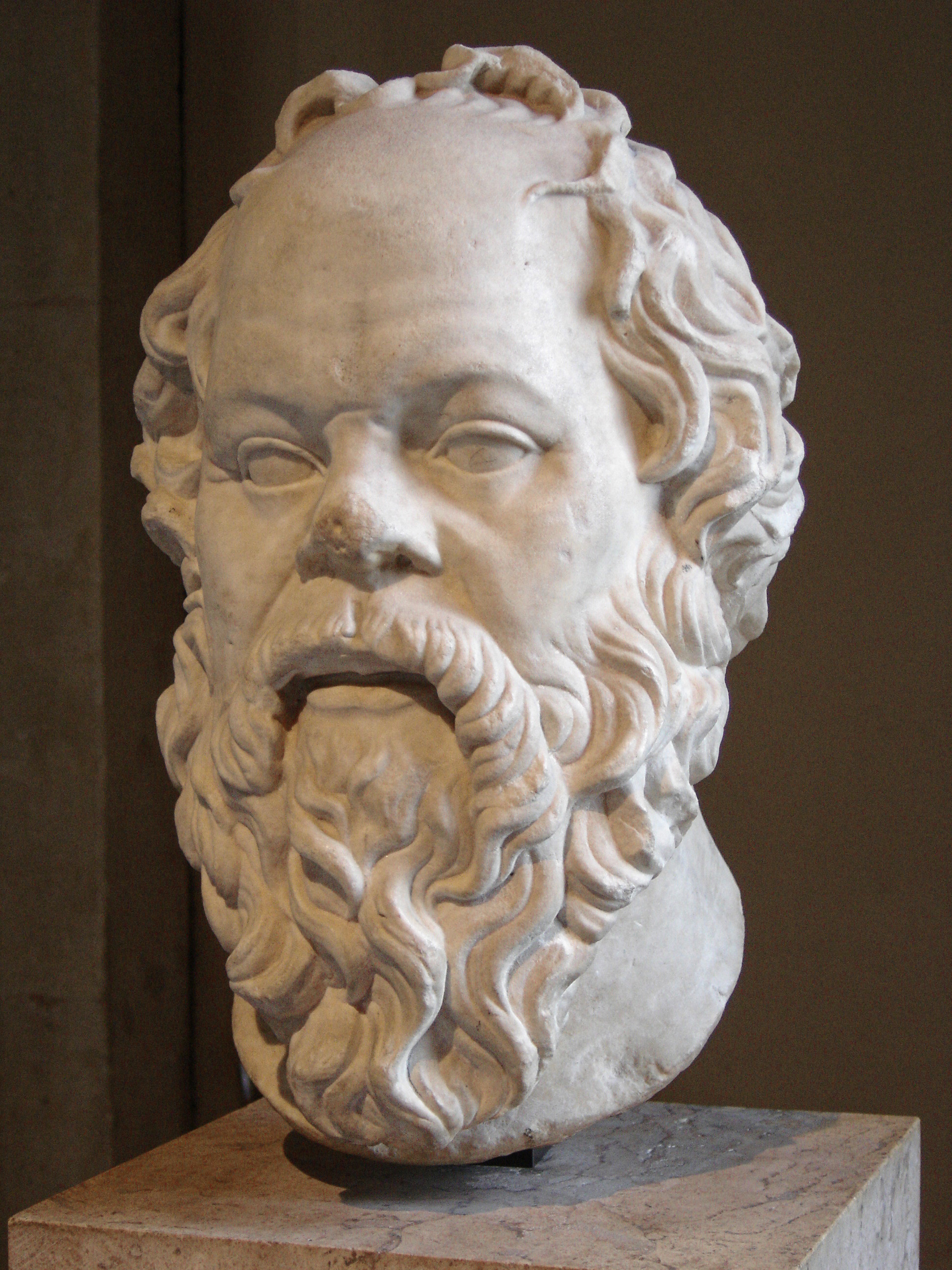
"Socrates rears his ugly head"
The figure of Socrates is ambiguous, troubling, and strangely disconcerting. The first surprise in store for us is his physical ugliness, which is well attested by the testimony of Plato, Xenophon, and Aristophanes. "It is significant," wrote Nietzsche, "that Socrates was the first great Hellene to be ugly. Everything in him is exaggerated, buffo, a caricature." Nietzsche goes on to evoke his "crab-like eyes, puffed-up lips, and hanging belly," and he takes pleasure in telling the story of how the physiognomist Zopyrus once told Socrates he was a monster, keeping hidden within himself the worst vices and appetites. Socrates, says Nietzsche, simply replied: "How well you know me!" If Socrates really did resemble a Silenus, as he is depicted in Plato's Symposium, such suspicions were quite understandable. In popular imagination, Sileni and satyrs were hybrid demons, half-animal, half-men, who made up the escort of Dionysos. These impudent, ribald buffoons also constituted the chorus of satyr-plays, a literary genre of which Euripides' Cyclops is one of the few remaining examples.Pierre Hadot's "Philosophy as a Way of Life" p. 148
The Silini were purely natural beings. They stood for the negation of culture and civilization, for grotesque buffoonery, and for the license of the instincts.
To use Kierkegaard's expression, Socrates was a cobold. To be sure, Plato gives us to understand that Socrates' resemblance to Silenus was only an appearance, beneath which something else was hidden. Alcibiades, in his famous speech in praise of Socrates at the end of the Symposium, compares Socrates to the little statues of Sileni that could be found in sculptors' shops, which concealed little figurines of the gods inside themselves. Similarly, Socrates' exterior appearance -- ugly, buffoon-like, impudent, almost monstrous -- was only a mask and a facade.
Here we are led to another paradox: Socrates was not only ugly, but a dissimulator as well. Nietzsche writes: "Everything in him is concealed, ulterior, subterranean." Socrates masks himself, and at the same time is used as a mask by others.
Socrates masks himself: here we encounter that famous Socratic irony, the meaning of which we shall have to clarify later on. Socrates pretends to be ignorant and impudent. "He spends his whole life," says Alcibiades, "playing the part of a simpleton and a child." "The nouns and verbs which form the outer envelope of his words are like the hide of an impudent satyr." His ignorant appearance and amorous attentions "are what he has wrapped around himself, like a carved Silenus."
Socrates pulled off his enterprise of dissimulation so well that he succeeded in definitively masking himself from history. He wrote nothing, engaging only in dialogue. All the testimonies we possess about him hide him from us more than they reveal him, precisely because Socrates has always been used as a mask by those who have spoken about him.
Tuesday, February 26, 2008
Pierre Hadot
I started reading Pierre Hadot's "Philosophy as a Way of Life". A friend recently passed along an essay and it seems like he's exploring exactly the areas I'm interested in. It turns out he also seems interested in many of the same thinkers. A quote from this NY Times article:
An aside -- Mention of Rilke towards the end of the nytimes article lead me to this Ursula K. Leguin quote (from this page with Rilke's "Archaic Torso of Apollo"):
... philosophy lost its connection to lived experience and became entirely an abstract, interpretive enterprise. Our modern universities, Hadot says, are the heirs of this tradition. He writes: ''The idea of a philosophy reduced to its conceptual content has survived to our own time. We encounter it every day in our university courses and in textbooks at every level; one could say that it is the classical, scholastic, university conception of philosophy.'' Continuing in this vein: ''The goal is no longer, as it was in antiquity, to train people for careers as human beings, but to train them for careers as clerks or professors -- that is to say, as specialists, theoreticians and retainers of specific items of more or less esoteric knowledge.''One more Hadot quote, this one from the introduction to the book.
Hadot does point to a countertradition, mainly but not wholly outside the university, that continues to uphold the ancient ideal, and it is clear that the names he names constitute his own syllabus for modern philosophy. Among those names are Erasmus, Montaigne (''My trade and my art is living''), the Descartes of the ''Meditations,'' Kant (''The idea of wisdom must be the foundation of philosophy''), Emerson, Marx, Nietzsche, William James, Wittgenstein, Jaspers. Rising to his full polemical height, Hadot speaks at the end about ''an urgent need to rediscover the ancient notion of the 'philosopher,' ''
The study of ancient philosophy has taught Hadot that 'human reality is so complex that one can only live it by using simultaneously or successively the most different methods: tension and relaxation, engagement and detachment, enthusiasm and reserve, certainty and criticism, passion and indifference.' Lessons in how to live human reality, with all that that implies -- those are the enduring lessons of ancient philosophy.This countertradition is what I relate to most. It's nice to rediscover the ancient notion of the philosopher but also to clarify who exactly we might describe as "philosopher" today (whether they call themselves such or no).
An aside -- Mention of Rilke towards the end of the nytimes article lead me to this Ursula K. Leguin quote (from this page with Rilke's "Archaic Torso of Apollo"):
When the genuine myth rises into consciousness, that is always its message. You must change your life.
Subscribe to:
Posts (Atom)

 Posts
Posts

