motto lotto
Showing posts with label Socrates. Show all posts

Wednesday, February 18, 2009

the philosopher-comedian

Every animal—therefore la bête philosophe [The philosophical animal], too—instinctively strives for an optimum of favorable conditions under which it can expend all its strength and achieve its maximal feeling of power; every animal abhors, just as instinctively and with a subtlety of discernment that is "higher than all reason," every kind of intrusion or hinderance that obstructs or could obstruct this path to the optimum (I am not speaking of its path to happiness, but its path to power, to action, to the most powerful activity, and in most cases its path to unhappiness). Thus the philosopher abhors marriage, together with that which might persuade to it—marriage being a hindrance and calamity on his path to the optimum. What great philosopher hitherto has been married? Heraclitus, Plato, Descartes, Spinoza, Leibniz, Kant, Schopenhauer—they were not; more, one cannot even imagine them married. A married philosopher belongs in comedy, that is my proposition—and as for that exception, Socrates—the malicious Socrates*, it would seem, married ironically, just to demonstrate this proposition.

Nietzsche GM 3.7 (Kaufmann *Socrates appears in Aristophanes' comedy The Clouds)

All I have been concerned to indicate here is this: in the most spiritual sphere too, the ascetic ideal has at present only one kind of real enemy capable of harming it: the comedians of this ideal—for they arouse mistrust of it. Everywhere else that the spirit is strong, mighty, and at work without counterfeit today, it does without ideals of any kind—the popular expression for this abstinence is "atheism"—except for its will to truth. But this will, this remnant of an ideal, is, if you will believe me, this ideal itself in its strictest, most spiritual forumlation, esoteric through and through, with all external additions abolished, and thus not so much its remnant as its kernel. Unconditional honest atheism (and its is the only air we breathe, we more spiritual men of this age!) is therefore not the antithesis of that ideal, as it appears to be; it is rather only one of the latest phases of its evolution, one of its terminal forms and inner consequences--it is the awe-inspiring catastrophe of two thousand years of training in truthfulness that finally forbids itself the lie involved in belief in God.

(The same evolutionary course in India, completely independent of ours, should prove something: the decisive point is reached five centuries before the beginning of the European calendar, with Buddha; more exactly, with the Sankhya philosophy, subsequently popularized by Buddha and made into a religion.)

Nietzsche GM 3.27 (Kaufmann)
All philosophers are single unless they're comedians.
I'm married. I'm a philosopher.
Ergo, I'm a comedian.

Mike (of Church of Mike) is a comedian of the latter variety.
Sunday, September 28, 2008

Pierre Hadot on Socrates' task

Socrates' task--entrusted to him, says the Apology, by the Delphic oracle (in other words, the god Apollo)--was therefore to make other people recognize their lack of knowledge and of wisdom. In order to accomplish this mission, Socrates himself adopted the attitude of someone who knew nothing--an attitude of naiveté . This is the well known Socratic irony: the feigned ignorance and candid air with which, for instance, he asked questions in order to find out whether someone was wiser than he. In the words of a character from the Republic: "That's certainly Socrates' old familiar irony! I knew it. I predicted to everyone present, Socrates, that you'd refuse to reply, that you'd feign ignorance, and that you'd do anything but reply if someone asked you a question."

This is why Socrates is always the questioner in his discussions. As Aristotle remarked, "He admits that he knows nothing." According to Cicero, "Socrates used to denigrate himself, and conceded more than was necessary to the interlocutors he wanted to refute. Thus, thinking one thing and saying another, he took pleasure in that dissimulation which the Greeks call 'irony.'" In fact, however, such an attitude is not a form of artifice or intentional dissimulation. Rather, it is a kind of humor which refuses to take oneself or other people seriously; for everything human, and even everything philosophical, is highly uncertain, and we have no right to be proud of it. Socrates' mission, then, was to make people aware of their lack of knowledge.
...
The real problem is therefore not the problem of knowing this or that, but of being in this or that way: "I have no concern at all for what most people are concerned about: financial affairs, administration of property, appointments to generalships, oratorical triumphs in public, magistracies, coalitions, political factions. I did not take this path... but rather the one where I could do the most good to each one of you in particular, by persuading you to be less concerned with what you have than what you are; so that you may make yourselves as excellent and as rational as possible." Socrates practiced this call to being not only by means of his interrogations and his irony, but above all by means of his way of being, by his way of life, and by his very being.

Pierre Hadot What is Ancient Philosophy p. 26,29*

Wednesday, June 11, 2008

reversals

Let that which stood in front go behind,
Let that which was behind advance to the front,
Let bigots, fools, unclean persons, offer new propositions,
Let the old propositions be postponed,
Let a man seek pleasure everywhere except in himself,
Let a woman seek happiness everywhere except in herself.

Walt Whitman
--
And Jesus said, "For judgment I came into this world, so that those who do not see may see, and that those who see may become blind."

Those of the Pharisees who were with Him heard these things and said to Him, "We are not blind too, are we?"

Jesus said to them, "If you were blind, you would have no sin; but since you say, 'We see,' your sin remains."

John 9:39-41 NASB
--
Well, although I do not suppose that either of us knows anything really beautiful and good, I am better off than he is,-- for he knows nothing, and thinks that he knows; I neither know nor think that I know.

Socrates (Plato's Apology - Jowett)

I once could see but now I'm blind. I was found but now I'm lost.

When I was a child, I used to speak like adults, think like adults, reason like adults. As a man I seek anew the voice of the child.*

Saturday, April 5, 2008

Michel de Montaigne (the other Frechman)


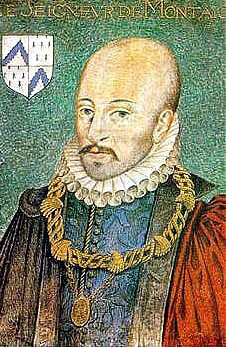
[C] Yet there is not one single school of philosophy which is not forced to allow its Sage (if he wishes to live) to accept a great many things which he cannot understand, perceive or give his assent to. Say he boards a ship. He carries out his design, not knowing whether it will serve his purpose; he assumes the vessel to be seaworthy, the pilot to be experienced and the weather to be favorable. Such attendant details are, of course, merely probable: he is obliged to let himself be guided by appearances, unless they are expressly contradicted. He has a body. He has a soul. He feels the impulsions of his senses and the promptings of his spirit. He cannot find within himself any sign specifically suggesting that it be appropriate for him to make an act of judgment: he realizes he must not bind his consent to anything, since something false may have every appearance of particular truth. Despite all this, he never fails to do his duty in his life, fully and fittingly.

How many disciplines are there which actually confess to be based on conjecture rather than on knowledge, and which, being unable to distinguish truth from falsehood, merely follow what seems likely? Pyrrhonians say that truth and falsehood exist: within us we have the means of looking for them, but not of making any lasting judgment: we have no touchstone.

We would be better off if we dropped our enquiries and let ourselves be moulded by the natural order of the world. A soul safe from prejudice has made a wondrous advance towards peace of mind. People who judge their judges and keep accounts of what they do fail to show due submissiveness. Among people who are amenable to the legitimate teachings of religion and politics, there are more simple and uninquisitive minds than minds which keep a schoolmasterly eye on causes human and divine.

[A] No system discovered by Man has greater usefulness nor a greater appearance of truth [than Pyrrhonism] which shows us man naked, empty, aware of his natural weaknesses, fit to accept outside help from on high: Man, stripped of all human learning and so all the more able to lodge the divine within him, annihilating his intellect to make room for faith;
...
[A] And so two out of the three generic schools of Philosophy make an express profession of doubt and ignorance; it is easy to discover that most who belonged to the third school, the Dogmatists, put on an assured face merely because it looks better. They did not really think they had established any certainties , but wanted to show us how far they had advanced in their hunt for Truth, [C] 'quam docti fingunt, magis quam norunt' [which the learned feign rather than know]. When Timaeus had to reveal to Socrates what he knew about the Gods, the world and mankind, he determined to speak of such things as one man to another: it would be enough if the reasons he gave had as much probablility as anyone else's, since precise reasons were neither in his grasp nor in the grasp of any mortal man.
...
I will unravel things as best I may. What I shall say is neither fixed nor certain: I am no Pythian Apollo; I am a little man seeking the probable through conjecture.
...
[A] Aristotle is the Prince of the Dogmatists; and yet it is from him we learn that greater knowledge leads to further doubt. You can often find him hiding behind a deliberate obscurity, so deep and impenetrable that you cannot make out what he meant. In practice it is Pyrrhonism cloaked in affirmation.
[C] Just listen to this assertion of Cicero ... Those who want to know what my personal opinions are on each of these subjects are more inquisitive than they ought to be. Up to now it has been a principle of philosophy to argue against anything but to decide nothing. This principle was established by Socrates; Arcesilus repeated it; Carneades strengthened it further. I am one of those who hold that there is, in all truths, an admixture of falsehood so like Truth that there is no way of deciding or determining anything whatever with complete certainty.
[B] Not only Aristotle but most philosophers aim at being hard to understand; why? -- if not to emphasize the vanity of their subject-matter and to give our minds something to do! Philosophy is a hollow bone with no flesh on it: are they providing us with a place to feed in, where we can chew on it?
...
Plato seems to me to have quite knowingly chosen to treat philosophy in the form of dialogues: he was better able to expound the diversity and variety of his concepts by putting them appropriately into the mouths of diverse speakers. Variety of treatment is as good as consistency. Better in fact: it means being more copious and more useful.
...
When philosophers find fault with each other, their widest field of action lies in the internal contradictions which entangle them all - either deliberately (so as to show the vacillations of the human mind over any subject whatever) or else quite unintentionally because all matters are shifting and elusive.
...
[A] We ought not to find it strange that people who despair of the kill should not renounce the pleasure of the hunt: study is, in itself, a delightful occupation, so delightful that, among the forbidden pleasures which need to be held on a tight reign, the Stoics include pleasure arising from exercising the mind. [C] They find intemperance in knowing too much.
...
[A] One of the Ancients was reproved for not judging philosophy to be of much account yet continuing to profess it; 'that is what being a philosopher means,' he replied.
Michel de Montaigne "An Apology for Raymond Sebond"
[ISBN 0-14-044493-9 p. 73-80]

Tuesday, April 1, 2008

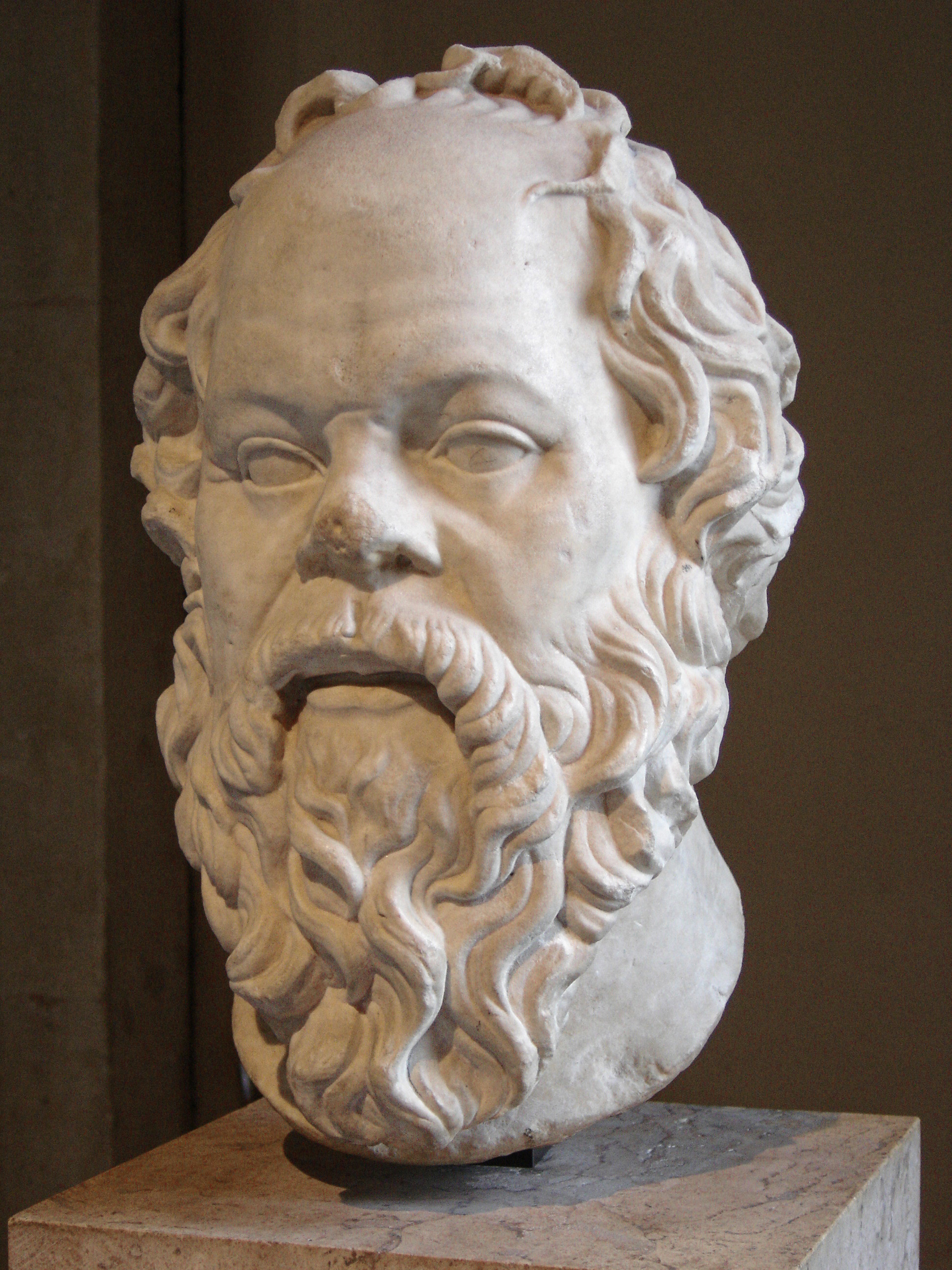
Socrates' Mask


"Socrates rears his ugly head"
The figure of Socrates is ambiguous, troubling, and strangely disconcerting. The first surprise in store for us is his physical ugliness, which is well attested by the testimony of Plato, Xenophon, and Aristophanes. "It is significant," wrote Nietzsche, "that Socrates was the first great Hellene to be ugly. Everything in him is exaggerated, buffo, a caricature." Nietzsche goes on to evoke his "crab-like eyes, puffed-up lips, and hanging belly," and he takes pleasure in telling the story of how the physiognomist Zopyrus once told Socrates he was a monster, keeping hidden within himself the worst vices and appetites. Socrates, says Nietzsche, simply replied: "How well you know me!" If Socrates really did resemble a Silenus, as he is depicted in Plato's Symposium, such suspicions were quite understandable. In popular imagination, Sileni and satyrs were hybrid demons, half-animal, half-men, who made up the escort of Dionysos. These impudent, ribald buffoons also constituted the chorus of satyr-plays, a literary genre of which Euripides' Cyclops is one of the few remaining examples.

The Silini were purely natural beings. They stood for the negation of culture and civilization, for grotesque buffoonery, and for the license of the instincts.

To use Kierkegaard's expression, Socrates was a cobold. To be sure, Plato gives us to understand that Socrates' resemblance to Silenus was only an appearance, beneath which something else was hidden. Alcibiades, in his famous speech in praise of Socrates at the end of the Symposium, compares Socrates to the little statues of Sileni that could be found in sculptors' shops, which concealed little figurines of the gods inside themselves. Similarly, Socrates' exterior appearance -- ugly, buffoon-like, impudent, almost monstrous -- was only a mask and a facade.

Here we are led to another paradox: Socrates was not only ugly, but a dissimulator as well. Nietzsche writes: "Everything in him is concealed, ulterior, subterranean." Socrates masks himself, and at the same time is used as a mask by others.

Socrates masks himself: here we encounter that famous Socratic irony, the meaning of which we shall have to clarify later on. Socrates pretends to be ignorant and impudent. "He spends his whole life," says Alcibiades, "playing the part of a simpleton and a child." "The nouns and verbs which form the outer envelope of his words are like the hide of an impudent satyr." His ignorant appearance and amorous attentions "are what he has wrapped around himself, like a carved Silenus."

Socrates pulled off his enterprise of dissimulation so well that he succeeded in definitively masking himself from history. He wrote nothing, engaging only in dialogue. All the testimonies we possess about him hide him from us more than they reveal him, precisely because Socrates has always been used as a mask by those who have spoken about him.
Pierre Hadot's "Philosophy as a Way of Life" p. 148