To You

Whoever you are, I fear you are walking the walks of dreams,
I fear these supposed realities are to melt from under your feet and hands,
Even now your features, joys, speech, house, trade, manners,
    troubles, follies, costume, crimes, dissipate away from you,
Your true soul and body appear before me.
They stand forth out of affairs, out of commerce, shops, work,
    farms, clothes, the house, buying, selling, eating, drinking,
    suffering, dying.

Whoever you are, now I place my hand upon you, that you be my poem,
I whisper with my lips close to your ear.
I have loved many women and men, but I love none better than you.

O I have been dilatory and dumb,
I should have made my way straight to you long ago,
I should have blabb'd nothing but you, I should have chanted nothing
    but you.

I will leave all and come and make the hymns of you,
None has understood you, but I understand you,
None has done justice to you, you have not done justice to yourself,
None but has found you imperfect, I only find no imperfection in you,
None but would subordinate you, I only am he who will never consent
    to subordinate you,
I only am he who places over you no master, owner, better, God,
    beyond what waits intrinsically in yourself.

Painters have painted their swarming groups and the centre-figure of all,
From the head of the centre-figure spreading a nimbus of gold-color'd light,
But I paint myriads of heads, but paint no head without its nimbus
    of gold-color'd light,
From my hand from the brain of every man and woman it streams,
    effulgently flowing forever.

O I could sing such grandeurs and glories about you!
You have not known what you are, you have slumber'd upon yourself
    all your life,
Your eyelids have been the same as closed most of the time,
What you have done returns already in mockeries,
(Your thrift, knowledge, prayers, if they do not return in
    mockeries, what is their return?)

The mockeries are not you,
Underneath them and within them I see you lurk,
I pursue you where none else has pursued you,
Silence, the desk, the flippant expression, the night, the
    accustom'd routine, if these conceal you from others or from
    yourself, they do not conceal you from me,
The shaved face, the unsteady eye, the impure complexion, if these
    balk others they do not balk me,
The pert apparel, the deform'd attitude, drunkenness, greed,
    premature death, all these I part aside.

There is no endowment in man or woman that is not tallied in you,
There is no virtue, no beauty in man or woman, but as good is in you,
No pluck, no endurance in others, but as good is in you,
No pleasure waiting for others, but an equal pleasure waits for you.

As for me, I give nothing to any one except I give the like carefully
    to you,
I sing the songs of the glory of none, not God, sooner than I sing
    the songs of the glory of you.

Whoever you are! claim your own at any hazard!
These shows of the East and West are tame compared to you,
These immense meadows, these interminable rivers, you are immense
    and interminable as they,
These furies, elements, storms, motions of Nature, throes of apparent
    dissolution, you are he or she who is master or mistress over them,
Master or mistress in your own right over Nature, elements, pain,
    passion, dissolution.

The hopples fall from your ankles, you find an unfailing sufficiency,
Old or young, male or female, rude, low, rejected by the rest,
    whatever you are promulges itself,
Through birth, life, death, burial, the means are provided, nothing
    is scanted,
Through angers, losses, ambition, ignorance, ennui, what you are
    picks its way.

Whitman Leaves of Grass*
Showing posts with label Whitman. Show all posts
Showing posts with label Whitman. Show all posts
Sunday, June 12, 2011
to you
Tuesday, March 2, 2010
the soul dissatisfied, curious, unconvinced at last
Life

Ever the undiscouraged, resolute, struggling soul of man;
(Have former armies fail'd? then we send fresh armies--and fresh again;)
Ever the grappled mystery of all earth's ages old or new;
Ever the eager eyes, hurrahs, the welcome-clapping hands, the loud
    applause;
Ever the soul dissatisfied, curious, unconvinced at last;
Struggling to-day the same--battling the same.

Walt Whitman*
Thursday, December 18, 2008
Jorge Luis Borges on poetry, argument
Had the poet said so in so many words, he would have been far less effective. Because, as I understand it, anything suggested is far more effective than anything laid down. Perhaps the human mind has the tendency to deny a statement. Remember what Emerson said: arguments convince nobody. They convince nobody because they are presented as arguments. Then we look at them, we weigh them, we turn them over, and we decide against them.
But when something is merely said or--better still--hinted at, there is a kind of hospitality in our imagination. We are ready to accept it. I remember reading, some thirty years ago, the works of Martin Buber--I thought of them as being wonderful poems. Then, when I went to Buenos Aires, I read a book by a friend of mine, Dujovne, and I found in its pages, much to my astonishment, that Martin Buber was a philosopher and that all his philosophy lay in the books I had read as poetry. Perhaps I had accepted those books because they came to me through poetry, through suggestion, through the music of poetry, and not as arguments. I think that somewhere in Walt Whitman the same idea can be found: the idea of reasons being unconvincing. I think he says somewhere that he finds the night air, the large few stars, far more convincing than mere arguments.
This Craft of Verse p.31-32 - Jorge Luis Borges
Sunday, December 14, 2008
Whitman on wisdom
Now I see the secret of the making of the best persons,
It is to grow in the open air and to eat and sleep with the earth.

Here a great personal deed has room,
(Such a deed seizes upon the hearts of the whole race of men,
Its effusion of strength and will overwhelms law and mocks all
    authority and all argument against it.)

Here is the test of wisdom,
Wisdom is not finally tested in schools,
Wisdom cannot be pass'd from one having it to another not having it,
Wisdom is of the soul, is not susceptible of proof, is its own proof,
Applies to all stages and objects and qualities and is content,
Is the certainty of the reality and immortality of things, and the
    excellence of things;
Something there is in the float of the sight of things that provokes
    it out of the soul.

Now I re-examine philosophies and religions,
They may prove well in lecture-rooms, yet not prove at all under the
    spacious clouds and along the landscape and flowing currents.

Here is realization,
Here is a man tallied--he realizes here what he has in him,
The past, the future, majesty, love--if they are vacant of you, you
    are vacant of them.

Walt Whitman Song of the Open Road
Wednesday, June 11, 2008
reversals
Let that which stood in front go behind,
Let that which was behind advance to the front,
Let bigots, fools, unclean persons, offer new propositions,
Let the old propositions be postponed,
Let a man seek pleasure everywhere except in himself,
Let a woman seek happiness everywhere except in herself.
Walt Whitman
--
And Jesus said, "For judgment I came into this world, so that those who do not see may see, and that those who see may become blind."
Those of the Pharisees who were with Him heard these things and said to Him, "We are not blind too, are we?"
Jesus said to them, "If you were blind, you would have no sin; but since you say, 'We see,' your sin remains."
John 9:39-41 NASB
--
Well, although I do not suppose that either of us knows anything really beautiful and good, I am better off than he is,-- for he knows nothing, and thinks that he knows; I neither know nor think that I know.
Socrates (Plato's Apology - Jowett)
I once could see but now I'm blind. I was found but now I'm lost.
When I was a child, I used to speak like adults, think like adults, reason like adults. As a man I seek anew the voice of the child.*
Wednesday, June 4, 2008
Whitman out of context
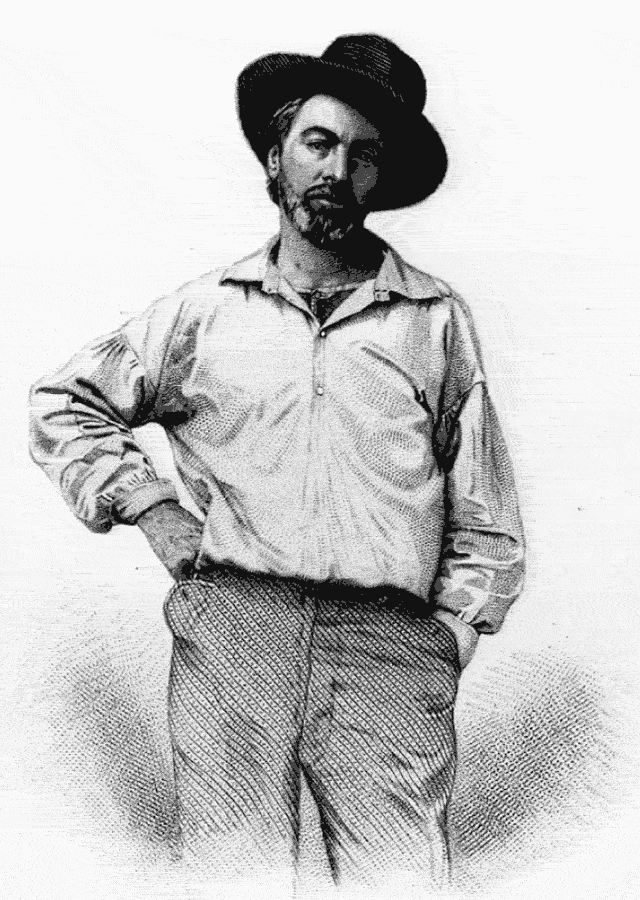 I've only really gotten into Whitman recently but that hasn't kept me from taking his lines and using them out of context in the past. Here are the lines I take out of context most.
Do I contradict myself?
Very well then I contradict myself,
(I am large, I contain multitudes.)
-and-
Births have brought us richness and variety,
And other births will bring us richness and variety.
I do not call one greater and one smaller,
That which fills its period and place is equal to any.
Here they are with context--
51

The past and present wilt--I have fill'd them, emptied them.
And proceed to fill my next fold of the future.

Listener up there! what have you to confide to me?
Look in my face while I snuff the sidle of evening,
(Talk honestly, no one else hears you, and I stay only a minute longer.)

Do I contradict myself?
Very well then I contradict myself,
(I am large, I contain multitudes.)

I concentrate toward them that are nigh, I wait on the door-slab.

Who has done his day's work? who will soonest be through with his supper?
Who wishes to walk with me?

Will you speak before I am gone? will you prove already too late?

--

44

It is time to explain myself--let us stand up.

What is known I strip away,
I launch all men and women forward with me into the Unknown.

The clock indicates the moment--but what does eternity indicate?

We have thus far exhausted trillions of winters and summers,
There are trillions ahead, and trillions ahead of them.

Births have brought us richness and variety,
And other births will bring us richness and variety.

I do not call one greater and one smaller,
That which fills its period and place is equal to any.

Were mankind murderous or jealous upon you, my brother, my sister?
I am sorry for you, they are not murderous or jealous upon me,
All has been gentle with me, I keep no account with lamentation,
(What have I to do with lamentation?)

I am an acme of things accomplish'd, and I an encloser of things to be.

My feet strike an apex of the apices of the stairs,
On every step bunches of ages, and larger bunches between the steps,
All below duly travel'd, and still I mount and mount.

Rise after rise bow the phantoms behind me,
Afar down I see the huge first Nothing, I know I was even there,
I waited unseen and always, and slept through the lethargic mist,
And took my time, and took no hurt from the fetid carbon.

Long I was hugg'd close--long and long.

Immense have been the preparations for me,
Faithful and friendly the arms that have help'd me.

Cycles ferried my cradle, rowing and rowing like cheerful boatmen,
For room to me stars kept aside in their own rings,
They sent influences to look after what was to hold me.

Before I was born out of my mother generations guided me,
My embryo has never been torpid, nothing could overlay it.

For it the nebula cohered to an orb,
The long slow strata piled to rest it on,
Vast vegetables gave it sustenance,
Monstrous sauroids transported it in their mouths and deposited it
 with care.

All forces have been steadily employ'd to complete and delight me,
Now on this spot I stand with my robust soul.

Walt Whitman "Song of Myself" Leaves of Grass
Monday, June 2, 2008
Whitman on the soul, body, God
48

I have said that the soul is not more than the body,
And I have said that the body is not more than the soul,
And nothing, not God, is greater to one than one's self is,
And whoever walks a furlong without sympathy walks to his own
    funeral drest in his shroud,
And I or you pocketless of a dime may purchase the pick of the earth,
And to glance with an eye or show a bean in its pod confounds the
    learning of all times,
And there is no trade or employment but the young man following it
    may become a hero,
And there is no object so soft but it makes a hub for the wheel'd universe,
And I say to any man or woman, Let your soul stand cool and composed
    before a million universes.

And I say to mankind, Be not curious about God,
For I who am curious about each am not curious about God,
(No array of terms can say how much I am at peace about God and
    about death.)

I hear and behold God in every object, yet understand God not in the least,
Nor do I understand who there can be more wonderful than myself.

Why should I wish to see God better than this day?
I see something of God each hour of the twenty-four, and each moment then,
In the faces of men and women I see God, and in my own face in the glass,
I find letters from God dropt in the street, and every one is sign'd
    by God's name,
And I leave them where they are, for I know that wheresoe'er I go,
Others will punctually come for ever and ever.

"Song of Myself" Leaves of Grass (Project Gutenberg)
When I read this section to Sarah she got stuck on the "Nor do I understand who there can be more wonderful than myself." With the light of some of the other lines of his I've posted hopefully it comes across less egotistical because I really think, to Whitman, self and others are cojoined.
Saturday, May 31, 2008
Whitman's sentiment
16
I am of old and young, of the foolish as much as the wise,
Regardless of others, ever regardful of others,
Maternal as well as paternal, a child as well as a man,
Stuff'd with the stuff that is coarse and stuff'd with the stuff
    that is fine,
One of the Nation of many nations, the smallest the same and the
    largest the same,
A Southerner soon as a Northerner, a planter nonchalant and
    hospitable down by the Oconee I live,
A Yankee bound my own way ready for trade, my joints the limberest
    joints on earth and the sternest joints on earth,
A Kentuckian walking the vale of the Elkhorn in my deer-skin
    leggings, a Louisianian or Georgian,
A boatman over lakes or bays or along coasts, a Hoosier, Badger, Buckeye;
At home on Kanadian snow-shoes or up in the bush, or with fishermen
    off Newfoundland,
At home in the fleet of ice-boats, sailing with the rest and tacking,
At home on the hills of Vermont or in the woods of Maine, or the
    Texan ranch,
Comrade of Californians, comrade of free North-Westerners, (loving
    their big proportions,)
Comrade of raftsmen and coalmen, comrade of all who shake hands
    and welcome to drink and meat,
A learner with the simplest, a teacher of the thoughtfullest,
A novice beginning yet experient of myriads of seasons,
Of every hue and caste am I, of every rank and religion,
A farmer, mechanic, artist, gentleman, sailor, quaker,
Prisoner, fancy-man, rowdy, lawyer, physician, priest.

I resist any thing better than my own diversity,
Breathe the air but leave plenty after me,
And am not stuck up, and am in my place.

(The moth and the fish-eggs are in their place,
The bright suns I see and the dark suns I cannot see are in their place,
The palpable is in its place and the impalpable is in its place.)

17
These are really the thoughts of all men in all ages and lands, they
    are not original with me,
If they are not yours as much as mine they are nothing, or next to nothing,
If they are not the riddle and the untying of the riddle they are nothing,
If they are not just as close as they are distant they are nothing.

This is the grass that grows wherever the land is and the water is,
This the common air that bathes the globe.

Walt Whitman "Song of Myself" Leaves of Grass (Project Gutenberg)
I like these lines as a snapshot of Whitman's larger project in Leaves of Grass which was something like "preach every one to everyone else". A friend of mine graduated law school recently and one of the profs quoted some Whitman to express the job of the lawyer. The prof didn't explain it so clearly but what I think she meant, from the lines of Whitman she read was "you need to learn to be the voice of every man". Because as lawyers they must be the voice for those they represent.
--
Compare Whitman's sentiment in the lines above with Nietzsche's sentiment:
“Pity for all”— would be hardness and tyranny toward you, my dear neighbor!—
BGE IV #82 (Kaufmann)
His statement is helpful as we think about morality in a more global context but the attitude associated with it isn't one I want to adopt. Nietzsche does recognize that generosity is genuine when produced by an overflow of the spirit (i'll have to dig up that quote) but I don't think he was after a generosity of spirit directly. It seems better to aim towards something closer to Whitman's attitude.
Wednesday, May 28, 2008
Whitman on metaphysics
The Base of All Metaphysics
And now gentlemen,
A word I give to remain in your memories and minds,
As base and finale too for all metaphysics.
(So to the students the old professor,
At the close of his crowded course.)
Having studied the new and antique, the Greek and Germanic systems,
Kant having studied and stated, Fichte and Schelling and Hegel,
Stated the lore of Plato, and Socrates greater than Plato,
And greater than Socrates sought and stated, Christ divine having
studied long,
I see reminiscent to-day those Greek and Germanic systems,
See the philosophies all, Christian churches and tenets see,
Yet underneath Socrates clearly see, and underneath Christ the divine I
see,
The dear love of man for his comrade, the attraction of friend to friend,
Of the well-married husband and wife, of children and parents,
Of city for city and land for land.
Walt Whitman's Leaves of Grass (Project Gutenberg)
Friday, May 16, 2008
Whitman's "Song of Myself" #43
I do not despise you priests, all time, the world over,
My faith is the greatest of faiths and the least of faiths,
Enclosing worship ancient and modern and all between ancient and modern,
Believing I shall come again upon the earth after five thousand years,
Waiting responses from oracles, honoring the gods, saluting the sun,
Making a fetich of the first rock or stump, powowing with sticks in
    the circle of obis,
Helping the llama or brahmin as he trims the lamps of the idols,
Dancing yet through the streets in a phallic procession, rapt and
    austere in the woods a gymnosophist,
Drinking mead from the skull-cap, to Shastas and Vedas admirant,
    minding the Koran,
Walking the teokallis, spotted with gore from the stone and knife,
    beating the serpent-skin drum,
Accepting the Gospels, accepting him that was crucified, knowing
    assuredly that he is divine,
To the mass kneeling or the puritan's prayer rising, or sitting
    patiently in a pew,
Ranting and frothing in my insane crisis, or waiting dead-like till
    my spirit arouses me,
Looking forth on pavement and land, or outside of pavement and land,
Belonging to the winders of the circuit of circuits.

One of that centripetal and centrifugal gang I turn and talk like
    man leaving charges before a journey.

Down-hearted doubters dull and excluded,
Frivolous, sullen, moping, angry, affected, dishearten'd, atheistical,
I know every one of you, I know the sea of torment, doubt, despair
    and unbelief.

How the flukes splash!
How they contort rapid as lightning, with spasms and spouts of blood!

Be at peace bloody flukes of doubters and sullen mopers,
I take my place among you as much as among any,
The past is the push of you, me, all, precisely the same,
And what is yet untried and afterward is for you, me, all, precisely
    the same.

I do not know what is untried and afterward,
But I know it will in its turn prove sufficient, and cannot fail.

Each who passes is consider'd, each who stops is consider'd, not
    single one can it fall.

It cannot fall the young man who died and was buried,
Nor the young woman who died and was put by his side,
Nor the little child that peep'd in at the door, and then drew back
    and was never seen again,
Nor the old man who has lived without purpose, and feels it with
    bitterness worse than gall,
Nor him in the poor house tubercled by rum and the bad disorder,
Nor the numberless slaughter'd and wreck'd, nor the brutish koboo
    call'd the ordure of humanity,
Nor the sacs merely floating with open mouths for food to slip in,
Nor any thing in the earth, or down in the oldest graves of the earth,
Nor any thing in the myriads of spheres, nor the myriads of myriads
    that inhabit them,
Nor the present, nor the least wisp that is known.
Leaves of Grass (Project Gutenberg)
Tuesday, April 29, 2008
from America to America
TO THE STATES
To the States or any one of them, or any city of the States,
Resist much, obey little,
Once unquestioning obedience, once fully enslaved,
Once fully enslaved, no nation, state, city, of this earth, ever
afterward resumes its liberty.
TO A PRESIDENT
All you are doing and saying is to America dangled mirages,
you have not learn'd of Nature--of the politics of Nature you
have not learned the great amplitude, recti-
tude, impartiality,
You have not seen that only such as they are for these States,
And that what is less than they must sooner or later lift off
from these States.
Walt Whitman, Leaves of Grass
Subscribe to:
Posts (Atom)

 Posts

