motto lotto

Tuesday, April 1, 2008

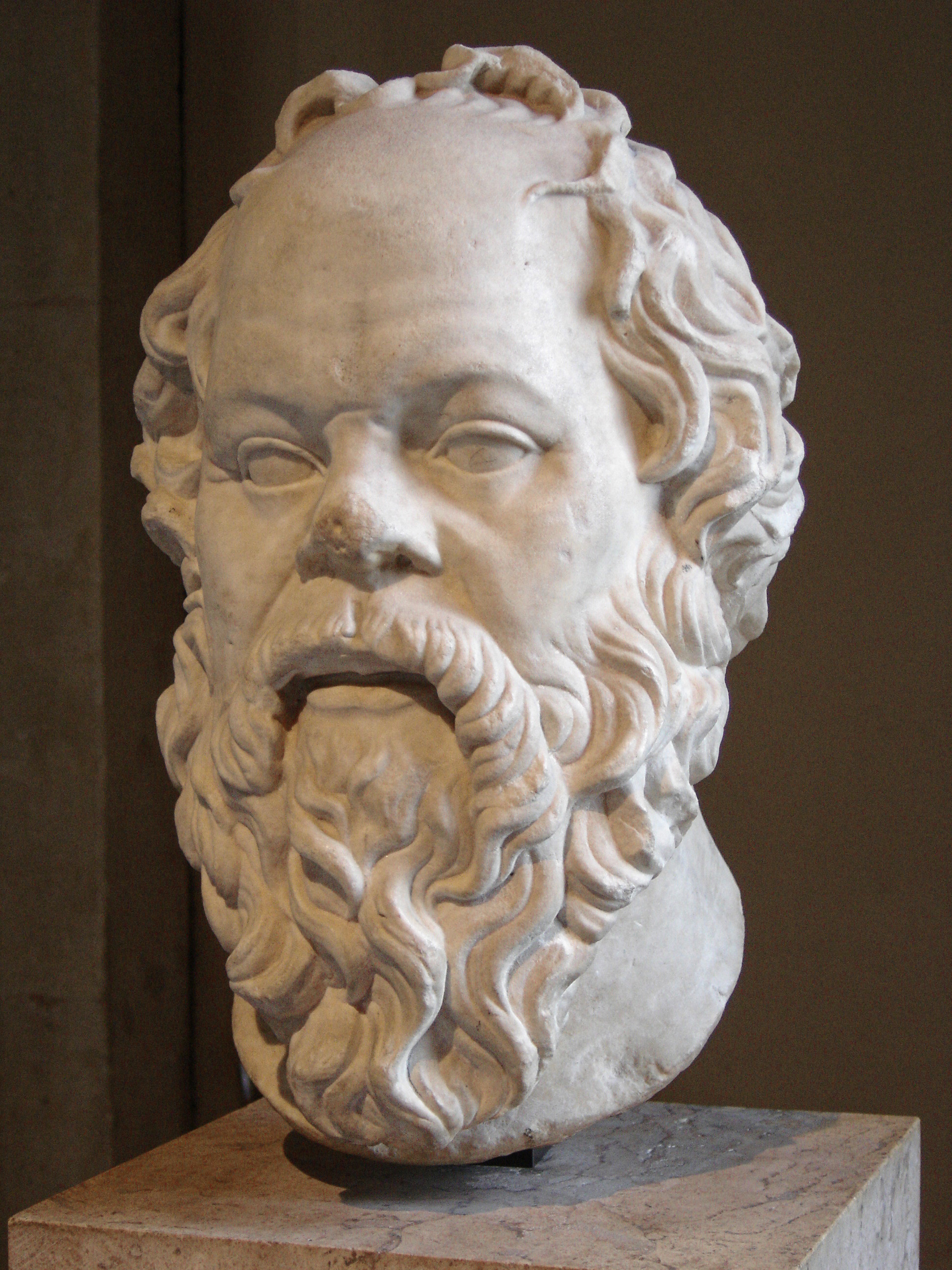
Socrates' Mask


"Socrates rears his ugly head"
The figure of Socrates is ambiguous, troubling, and strangely disconcerting. The first surprise in store for us is his physical ugliness, which is well attested by the testimony of Plato, Xenophon, and Aristophanes. "It is significant," wrote Nietzsche, "that Socrates was the first great Hellene to be ugly. Everything in him is exaggerated, buffo, a caricature." Nietzsche goes on to evoke his "crab-like eyes, puffed-up lips, and hanging belly," and he takes pleasure in telling the story of how the physiognomist Zopyrus once told Socrates he was a monster, keeping hidden within himself the worst vices and appetites. Socrates, says Nietzsche, simply replied: "How well you know me!" If Socrates really did resemble a Silenus, as he is depicted in Plato's Symposium, such suspicions were quite understandable. In popular imagination, Sileni and satyrs were hybrid demons, half-animal, half-men, who made up the escort of Dionysos. These impudent, ribald buffoons also constituted the chorus of satyr-plays, a literary genre of which Euripides' Cyclops is one of the few remaining examples.

The Silini were purely natural beings. They stood for the negation of culture and civilization, for grotesque buffoonery, and for the license of the instincts.

To use Kierkegaard's expression, Socrates was a cobold. To be sure, Plato gives us to understand that Socrates' resemblance to Silenus was only an appearance, beneath which something else was hidden. Alcibiades, in his famous speech in praise of Socrates at the end of the Symposium, compares Socrates to the little statues of Sileni that could be found in sculptors' shops, which concealed little figurines of the gods inside themselves. Similarly, Socrates' exterior appearance -- ugly, buffoon-like, impudent, almost monstrous -- was only a mask and a facade.

Here we are led to another paradox: Socrates was not only ugly, but a dissimulator as well. Nietzsche writes: "Everything in him is concealed, ulterior, subterranean." Socrates masks himself, and at the same time is used as a mask by others.

Socrates masks himself: here we encounter that famous Socratic irony, the meaning of which we shall have to clarify later on. Socrates pretends to be ignorant and impudent. "He spends his whole life," says Alcibiades, "playing the part of a simpleton and a child." "The nouns and verbs which form the outer envelope of his words are like the hide of an impudent satyr." His ignorant appearance and amorous attentions "are what he has wrapped around himself, like a carved Silenus."

Socrates pulled off his enterprise of dissimulation so well that he succeeded in definitively masking himself from history. He wrote nothing, engaging only in dialogue. All the testimonies we possess about him hide him from us more than they reveal him, precisely because Socrates has always been used as a mask by those who have spoken about him.
Pierre Hadot's "Philosophy as a Way of Life" p. 148

Friday, March 28, 2008

Nietzsche's Mask?

I don't think I have a good handle on this section. I understand that everything profound wears a mask (i.e. the shallow reading) but it also seems Nietzsche wants to embrace a mask. Is the mask he wants to embrace simply the one that he wears or understanding these appearances is he attempting to design his mask? Kaufmann thinks this section helps provide insights for interpretation. For me this section is one of the hardest to interpret. Any insight would be appreciated.
Everything profound loves masks. The most profound things of all even have a hatred for images and allegories. Shouldn’t the right disguise in which the shame of a god walks around be something exactly opposite? A questionable question: it would be strange if some mystic or other had not already ventured something like that on his own.

There are processes of such a delicate sort that people do well to bury them in something crude and make them unrecognizable. There are actions of love and of extravagant generosity, after which there is nothing more advisable than to grab a stick and give an eyewitness a good thrashing: — in so doing we cloud his memory. Some people know how to befuddle or batter their own memories in order at least to take revenge on this single witness: — shame is resourceful.

It is not the worst things that make people feel the worst shame. Behind a mask there is not only malice — there is so much goodness in cunning. I could imagine that a person who had something valuable and vulnerable to hide might roll through his life as coarse and round as an old green wine barrel with strong hoops. The delicacy of his shame wants it that way. For a person whose shame is profound runs into his fate and delicate decisions on pathways which few people ever reach and of whose existence those closest to him and his most intimate associates are not permitted to know. His mortal danger hides itself from their eyes, just as much as his confidence in life does, once he regains it

A person who is concealed in this way, who from instinct uses speaking for silence and keeping quiet and who is tireless in avoiding communication, wants and demands that, instead of him, a mask of him wanders around in the hearts and heads of his friends. And suppose he does not want that mask: one day his eyes will open to the fact that nonetheless there is a mask of him there — and that that’s a good thing. Every profound spirit needs a mask; even more, around every profound spirit a mask is continuously growing, thanks to the constantly false, that is, shallow interpretation of every word, every step, every sign of life he gives. — BGE Section 40 (Ian Johnston)
Kaufmann's note (minus specific Jaspers references) --
This section is obviously of great importance for the student of Nietzsche: it suggests plainly that the surface meaning noted by superficial browsers often masks Nietzsche's real meaning, which in extreme cases may approximate the opposite of what the words might suggest to hasty readers. In this sense "beyond good and evil" and "will to power," "master morality" and "hardness" and "cruelty" may be masks that elicit reactions quite inappropriate to what lies behind them. Specific examples will be found on later pages.

Karl Jaspers has called attention to the similarity between Nietzsche and Kierkegaard at this point, in his lecture on Kierkegaard and Nietzsche.

Wednesday, March 26, 2008

more on the philosopher as traveler

1/26/2008

Communication and honesty go hand in hand. You participate in them with others to the extent they have earned your trust.

Some also call what they do when they use people as simply a means "communication".
--
Meditations are for honesty, not for truth. In contrast to how philosophy has seen itself.
--
Philosophers often speak about "man" or "all men" when they're usually talking about one man, themselves.

This is hardly an original thought, as if thoughts should only be adopted and promoted when they're original. Copyright- what a stupid, horrendous, inhuman lesson. A widely adopted and enforced, self refuting concept. Nothing is ever entirely your own, at best it's your own "and".
--
In contrast to Descartes you don't pursue that which you cannot doubt but rather pay attention, where you are. I actually think this is what he did though it's not how we've traditionally understood it. This whipping boy (Dubito, ergo cogito, ergo sum) should be lauded for waking again a false consciousness.
--
Each other philosophy is a journey. Similar to a journey in the world. You see the landscape, the way of being and you learn. These journeys provide methods with which to engage the world, to understand.

A philosopher is then a master of approach, of method. He may be a fountain of knowledge and wisdom but that's not where his true value lies.

2/10/2008

Examining other philosophers with an eye toward objective truth is like attempting to learn from an athlete by examining their currently held records.

What is learned is in the person, in her way of being in and perceiving the world. What we gain is a new attitude and approach, not new metaphysical clutter. So what we're looking for is relevancy and humanity.

Sunday, March 23, 2008

Scribblings

2/15/2008
A philosopher settling upon a previously defined view of the world is like a life-long climber setting up his residence on a mountaintop and throwing away all his gear. Perhaps he's done with struggle and thus awaits death?

2/23/2008
The philosopher as traveler adopts beliefs for their therapeutic value instead of for their truth value. That doesn't mean the beliefs are not true.

They are not after beliefs, ideas, and truth so much as a better life, better ability to enjoy and respect life.

They've seen those who create the world in their own image and seek instead to explore the world. They discover instead of create not because they don't create but because they embody the attitude of wonder.

When you read the travelers you don't take away their truths, you take away lessons for living. "lessons for living" sounds trite, it's not. Rather, it's overfamiliar through misuse.

Wednesday, March 12, 2008

Who is a philosopher? (Nietzsche)

I've been reading Beyond Good & Evil (Kaufmann) and decided to gather some quotes regarding who Nietzsche recognizes as "philosopher". I'll keep adding to this as I get a better idea of Nietzsche's answer to the question.
Perhaps hardness and cunning furnish more favorable conditions for the origin of the strong, independent spirit and philosopher than that gentle, fine, conciliatory good-naturedness and art of taking things lightly which people prize, and prize rightly, in a scholar. Assuming first of all that the concept "philosopher" is not restricted to the philsopher who writes books--or makes books of his philosophy. -Part II Section 39

Are these coming philosophers new friends of "truth"? That is probable enough, for all philosophers so far have loved their truths. But they will certainly not be dogmatists. It must offend their pride, also their taste, if their truth is supposed to be a truth for everyman --which has so far been the secret wish and hidden meaning of all dogmatic aspirations. "My judgement is my judgment": no one else is easily entitled to it--that is what such a philospher of the future may perhaps say of himself. -Part II Section 43

Section 44 gets more into his idea of who the "philosophers of the future" will be.

Monday, March 3, 2008

Friday, February 29, 2008

Humanity's typical answer --


Make some creeds.
Get more people to accept those creeds.
Villanize those who don’t agree.
Repeat.

Tuesday, February 26, 2008

Pierre Hadot

I started reading Pierre Hadot's "Philosophy as a Way of Life". A friend recently passed along an essay and it seems like he's exploring exactly the areas I'm interested in. It turns out he also seems interested in many of the same thinkers. A quote from this NY Times article:
... philosophy lost its connection to lived experience and became entirely an abstract, interpretive enterprise. Our modern universities, Hadot says, are the heirs of this tradition. He writes: ''The idea of a philosophy reduced to its conceptual content has survived to our own time. We encounter it every day in our university courses and in textbooks at every level; one could say that it is the classical, scholastic, university conception of philosophy.'' Continuing in this vein: ''The goal is no longer, as it was in antiquity, to train people for careers as human beings, but to train them for careers as clerks or professors -- that is to say, as specialists, theoreticians and retainers of specific items of more or less esoteric knowledge.''

Hadot does point to a countertradition, mainly but not wholly outside the university, that continues to uphold the ancient ideal, and it is clear that the names he names constitute his own syllabus for modern philosophy. Among those names are Erasmus, Montaigne (''My trade and my art is living''), the Descartes of the ''Meditations,'' Kant (''The idea of wisdom must be the foundation of philosophy''), Emerson, Marx, Nietzsche, William James, Wittgenstein, Jaspers. Rising to his full polemical height, Hadot speaks at the end about ''an urgent need to rediscover the ancient notion of the 'philosopher,' ''
One more Hadot quote, this one from the introduction to the book.
The study of ancient philosophy has taught Hadot that 'human reality is so complex that one can only live it by using simultaneously or successively the most different methods: tension and relaxation, engagement and detachment, enthusiasm and reserve, certainty and criticism, passion and indifference.' Lessons in how to live human reality, with all that that implies -- those are the enduring lessons of ancient philosophy.
This countertradition is what I relate to most. It's nice to rediscover the ancient notion of the philosopher but also to clarify who exactly we might describe as "philosopher" today (whether they call themselves such or no).

An aside -- Mention of Rilke towards the end of the nytimes article lead me to this Ursula K. Leguin quote (from this page with Rilke's "Archaic Torso of Apollo"):
When the genuine myth rises into consciousness, that is always its message. You must change your life.

Tuesday, February 5, 2008

Vonnegut's "Medical Opinion on the Effects of a Writers' Strike"

    "I'm thinking of calling a general strike of all writers until mankind finally comes to its senses. Would you support it?"
    "Do writers have a right to strike? That would be like the police or the firemen walking out."
    "Or the college professors."
    "Or the college professors," I agreed. I shook my head. "No, I don't think my conscience would let me support a strike like that. When a man becomes a writer, I think he takes on a sacred obligation to produce beauty and enlightenment and comfort at top speed."
    "I just can't help thinking what a shaking up it would give people if, all of a sudden, there were no new books, new plays, new histories, new poems . . ."
    "And how proud would you be when people started dying like flies?" I demanded.
    "They'd die more like mad dogs, I think--snarling and snapping at each other and biting their own tails."
    I turned to Castle the elder. "Sir, how does a man die when he's deprived of the consolations of literature?"
    "In one of two ways," he said, "petrescence of the heart or atrophy of the nervous system."
-From "Cat's Cradle" Kurt Vonnegut, Jr.

This might also contribute to Huenemann's discussion about the value of the humanities.